
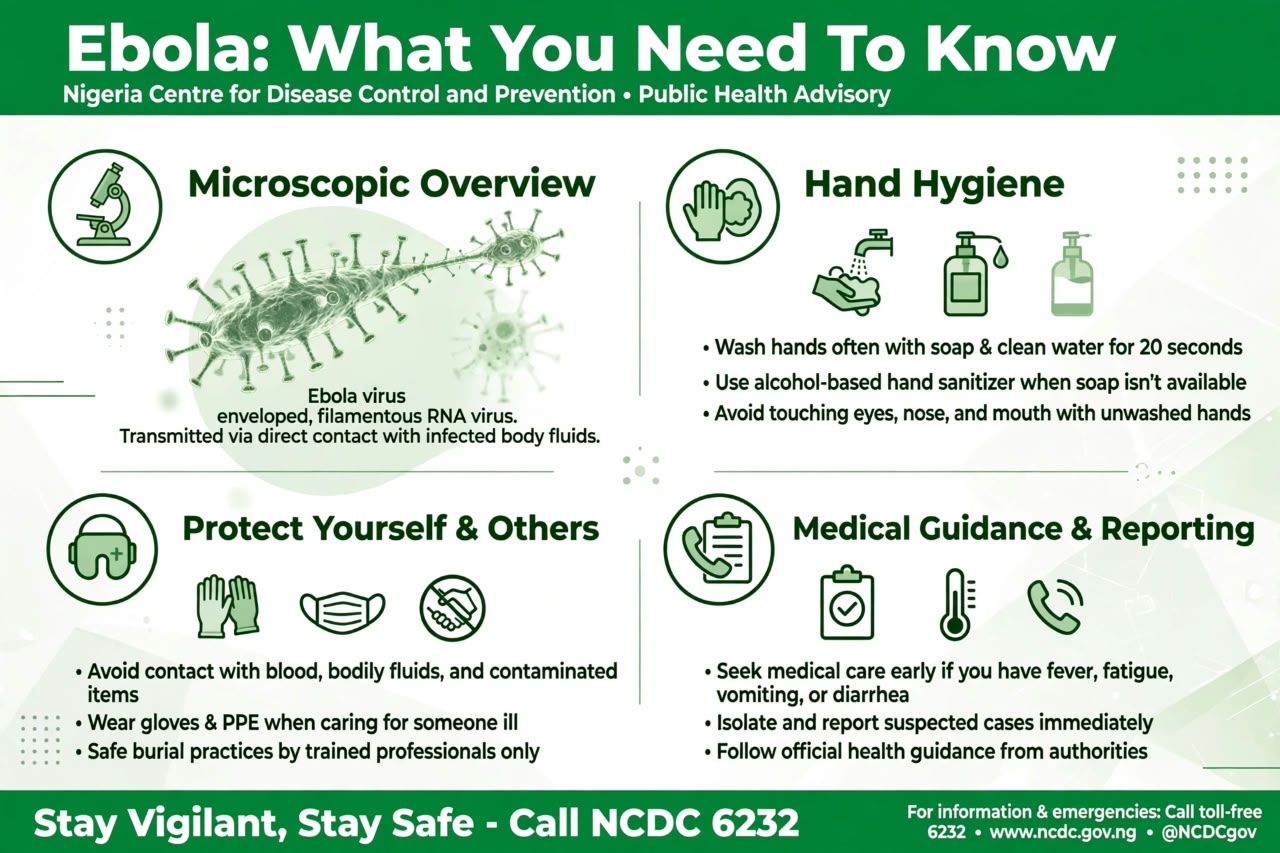
The Federal Government has urged healthcare facilities across Nigeria to remain vigilant following the laboratory confirmation of an Ebola disease case in the Federal Capital Territory (FCT). NCDC toll-free line 6232 has been activated for reporting suspected cases The government said the case involved a woman who recently arrived in Nigeria on an international flight from Uganda and was admitted to a private hospital in the FCT, where she received care for several days before the diagnosis was confirmed. In a press statement issued on Tuesday, October 20, 2026, and signed by the Coordinating Minister of Health and Social Welfare, Prof. Muhammad Ali Pate, the government said the patient was currently in isolation and receiving medical care. The statement said contact tracing had commenced, with 44 close contacts identified so far. Public health teams are identifying and monitoring people who may have been exposed to the infection, including healthcare workers, patients, caregivers and travel contacts. The Federal Ministry of Health and Social Welfare, the Nigeria Centre for Disease Control and Prevention (NCDC), the FCT Health Services Secretariat and other relevant authorities are working together to contain the infection and prevent further spread. The government said it had intensified surveillance, while the hospital that treated the patient received immediate support to strengthen infection prevention and control measures. It called on public and private healthcare facilities nationwide to remain on high alert, urging healthcare workers to promptly identify and isolate suspected cases, maintain strict infection prevention and control measures, and immediately report suspected cases to public health authorities. “Healthcare workers must maintain a high index of suspicion, promptly identify and isolate suspected cases, observe strict infection prevention and control measures, and immediately report suspected cases to public health authorities,” the statement said. The government also called for vigilance across the healthcare sector as public health teams continue efforts to monitor potential exposures and prevent further transmission. The statement reaffirmed the government’s commitment to working with relevant health authorities to contain the infection and protect public health. FEDERAL GOVERNMENT OF NIGERIA • NCDC www.ncdc.gov.ng | WhatsApp: +234 800 000 6232 WHAT NIGERIANS SHOULD KNOW AND DO FG Confirms Ebola Disease Case in FCT – 20 October 2026 – Federal Government Advisory i Ebola spreads through direct contact with the blood or body fluids of someone who is sick with the disease or has died from it, or through contact with contaminated materials. A person with Ebola cannot spread the disease before symptoms begin. Key Advisory — What to Know & Do 😌 1. Remain calm but vigilant.There is no need for panic. 🧼 2. Practise regular hand hygieneand avoid contact with the body fluids of anyone suspected to have Ebola. 🌡️ 3. Watch for symptoms, includingfever, severe weakness, headache, vomiting and diarrhoea, particularly following possible exposure. 📞 4. Report any possible exposure immediately, even if you feel well.If you develop symptoms, avoid close contact with others and call public health authorities for guidance before visiting a healthcare facility. 🤝 5. Cooperate with public health teams.Anyone contacted during contact tracing, including relevant airline passengers, should provide the necessary information and follow public health advice. 🔇 6. Avoid rumours and stigma.Share only verified information from official health authorities. For more info: www.ncdc.gov.ng • WhatsApp: +234 800 000 6232 NCDC toll-free 6232 – 24 hours, 7 days a week Infographic: Based on FG Advisory 20 Oct 2026 & NCDC guidance. Design: WAMAC. Source: Federal Ministry of Health & NCDC. Government Assures Nigerians of Response to Ebola Case The Federal Government has recalled Nigeria’s successful containment of Ebola in 2014, expressing confidence in the country’s experience and public health systems to respond to the current case.For information or to report a suspected case, Nigerians can contact the NCDC’s 24-hour toll-free call centre on 6232. ✅ Quick Guide: What Nigerians Should Do Wash hands frequently with soap and water or alcohol sanitizer Avoid direct contact with blood or body fluids of a sick person Healthcare workers – maintain high index of suspicion, use PPE, isolate suspected cases Report suspected cases immediately: NCDC Toll-Free 6232 or your State Epidemiology Team Avoid spreading unverified reports – rely on NCDC & Federal Ministry of Health Source: FG Advisory 20 Oct 2026 / NCDC. Graphic: WAMAC – Ebola_What_You_Need_To_Know
Beyond ₦53,000: The ICPC Chairman Case and Police Accountability in Nigeria
The alleged extortion of the ICPC Chairman by police officers in Abuja, Nigeria, became more than a disciplinary case. It prompted wider conversations about police accountability, public trust and the relationship between citizens and law enforcement. Few stories captured Nigeria’s governance conversation in July 2026 as much as the alleged extortion of the ICPC Chairman, Dr. Musa Aliyu, SAN, by some police officers in the nation’s capital, Abuja. What began as an allegation involving ₦53,000 quickly evolved into a national conversation that extended far beyond the incident, raising broader questions about policing, accountability, and public trust. According to the Federal Capital Territory (FCT) Police Command, four officers were arrested after the command received reports that they allegedly extorted the ICPC Chairman, prompting an investigation that quickly drew national attention. While the allegation involved ₦53,000, the national conversation that followed extended far beyond the money. The incident raised broader questions about policing, accountability, governance and public trust. From One Encounter to a National Conversation For many motorists and commuters in Abuja, encounters with police checkpoints are part of everyday life. While many end without incident, others have been accompanied by complaints ranging from harassment and unlawful searches to allegations of extortion. It was against this familiar backdrop that the alleged extortion of the Chairman of the Independent Corrupt Practices and Other Related Offences Commission (ICPC), Dr. Musa Adamu Aliyu, SAN, unfolded. According to the Federal Capital Territory (FCT) Police Command, the complaint prompted an investigation that led to the arrest of four police officers. Speaking during a press briefing, Commissioner of Police Ahmed Sanusi addressed the allegations directly. “We have about four policemen in custody as we speak… They extorted the Chairman of the ICPC.” The Commissioner went on to outline the allegations in greater detail. “They said ₦53,000. The man followed them gently. They took him to POS. He paid charges for the POS. They withdrew the money and shared it among themselves.” — FCT Commissioner of Police, Ahmed Sanusi, describing how officers extorted the ICPC Chairman He further disclosed that the officers were allegedly operating outside their authorised duty post. “That was not even their duty post. They are a gang of criminals left from various divisions, clustered together and moved to Wuse bypass and then created a checkpoint there.” — FCT CP Ahmed Sanusi According to the Commissioner, the officers were subsequently declared wanted before they were apprehended. The Police response became an important part of the story. Rather than dismissing the allegations, the FCT Police Command publicly announced the arrests and an investigation. Phone Searches: Drawing the Line Between Suspicion and Due Process Beyond the disciplinary action against the officers, the case prompted the FCT Police Command to clarify an issue that affects many Nigerians: the circumstances under which police officers may search a person’s mobile phone. Commissioner of Police Ahmed Sanusi stated unequivocally that officers are not permitted to stop members of the public during routine encounters and demand access to their phones. “You cannot stop anybody on the road and ask the person to bring out his phone for search. If any policeman stops you and asks to search your phone, don’t agree. Call the police emergency lines and we will ask them why.” — FCT CP Ahmed Sanusi He added that the Command had repeatedly instructed officers against conducting phone searches based solely on suspicion. “It has been instructed that nobody should search any phone, especially when you just arrest somebody on the road because you suspect the person to be a ‘Yahoo Yahoo’ or so.” At the same time, the Commissioner emphasised that mobile phones can legitimately form part of criminal investigations where due process has been followed. “It has been instructed that nobody should search any phone, especially when you just arrest somebody on the road because you suspect the person to be a ‘Yahoo Yahoo’ or so.” “This does not negate the fact that phones are also being used to commit crime. Before such a thing can happen, the person must have committed the crime, been properly arrested, and brought to the station.” — FCT CP Ahmed Sanusi The distinction is significant. It addresses a question that has featured prominently in public discussions about policing in Nigeria: where does legitimate criminal investigation end and arbitrary roadside phone searches begin? According to the FCT Police Command, that distinction lies in due process rather than mere suspicion. Speaking Up, Strengthening Accountability The alleged extortion of the ICPC Chairman raises broader questions than the outcome of a single disciplinary case. It also highlights one of the most difficult aspects of police accountability: misconduct can only be investigated when citizens are willing and able to report it. This broader institutional perspective was reflected in the response of Inspector-General of Police Olatunji Disu. Rather than suggesting that misconduct no longer exists within the Force, the Inspector-General acknowledged that policing, like every human institution, faces challenges. The real test, he argued, is not whether wrongdoing occurs, but whether it is confronted openly, investigated promptly and addressed decisively. “We are a force that will not come out and lie to you that things are perfect… The most important thing is, what did we do about it?” — Inspector-General of Police Olatunji Disu The same message was echoed by FCT Commissioner of Police A.M. Sanusi. Explaining how the officers were identified and arrested, he stressed that the Command was able to act because the incident was reported. “We were able to achieve this because it was reported to us. If you keep quiet out of fear of intimidation or further harassment, you will be undoing yourself. If you tell us, it will stop that fear and stop that intimidation.” — FCT CP Ahmed Sanusi Inspector-General Disu also urged Nigerians to make use of the Nigeria Police Force’s Complaints Response Units (CRU) and other official reporting channels. “If anything happens, ensure that you complain, so that we can act on it.” — Inspector-General of Police Olatunji Disu Those appeals
Resilience Beyond Donors: Why Africa’s Civil Society Must Build on Solid Ground
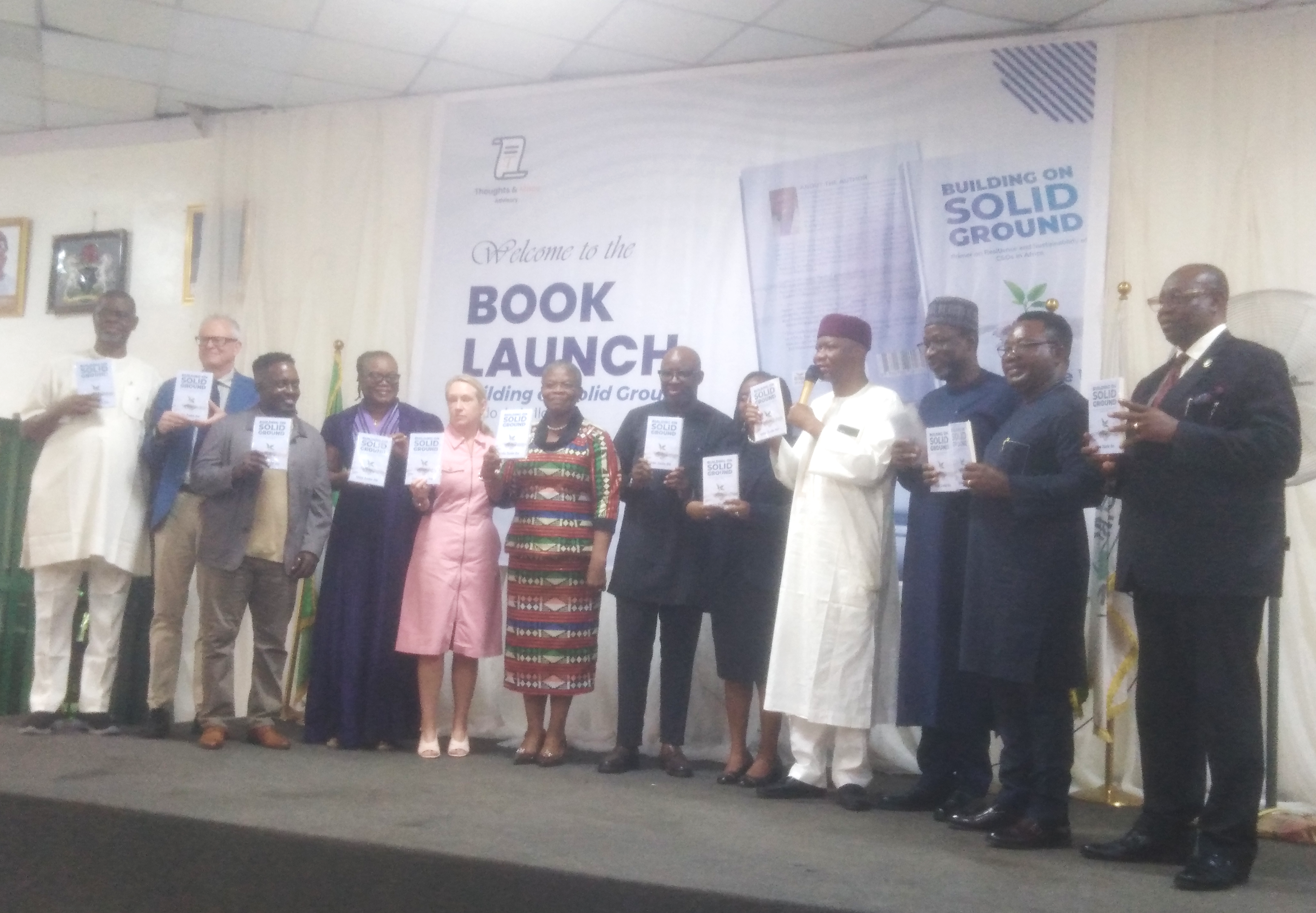
By Nonye Aghaji One of the defining moments for African civil society in mid-2026 unfolded in Abuja when practitioners, policymakers, diplomats, and activists gathered for the public presentation of Building on Solid Ground: Primer on Resilience and Sustainability of CSOs in Africa by Udo Jude Ilo. What began as a book launch quickly became a deeper conversation about the future of citizen-led movements on the continent. For decades, civil society has been Africa’s moral conscience; from resisting military rule and supporting pro-democracy struggles to tracking public budgets, fighting gender-based violence, and protecting electoral integrity. Yet beneath this legacy lies a difficult reality. Many of the organisations that hold power accountable are themselves facing challenges of sustainability, donor dependency, and institutional survival. The Reality of the Funding Cliff Delivering the keynote address, Dr. Obiageli “Oby” Ezekwesili, former Vice President of the World Bank for Africa and former Minister of Education, described the current situation as “the most disruptive funding shock in generations.” With funding cuts from traditional development partners such as USAID, the UK’s Foreign, Commonwealth and Development Office (FCDO), and several Nordic donors, many organisations across Africa have been forced to scale down programmes, lay off staff, or shut their doors altogether. “The moment our funding source can collapse our organizations, our funding source has become our master,” Ezekwesili warned. She argued that resilience should not be treated as a conference buzzword but as a daily responsibility for organisations committed to social change. “We are in a state of fragility where we need an anti-fragility strategy, and sustainability and resilience are the most effective anti-fragility strategies,” she said. “It must be elevated from a sector survival conversation to an African self-determination conversation.” Moving from Personalities to Institutions Reviewing the book, Dr. Otive Igbuzor, Founding Executive Director of the African Centre for Leadership, Strategy and Development (Centre LSD), pointed to another challenge confronting the sector. According to him, many organisations remain heavily dependent on their founders, making them vulnerable when leadership changes. “Many organizations collapse once founders leave because systems, structures, and institutional culture were never developed,” he noted. The book argues that long-term sustainability requires organisations to invest in strategy, governance, talent development, fundraising, and visibility. More importantly, it places strategy and governance before fundraising, challenging the belief that money alone guarantees institutional survival. Global Ambition, Local Roots For Dr. Kole Shettima, Country Director of the MacArthur Foundation, the conversation was also about ownership and ambition. He stressed the importance of Africans documenting their own experiences and telling their own stories rather than relying on outsiders to define the continent’s realities. Shettima highlighted organisations such as BudgIT, Follow The Money, and LEAP Africa, which began as local initiatives but have grown into internationally recognised institutions. “Why don’t we have more African organizations at the global level, so our people can stop working for imperial organizations and work for our own internationalized bodies?” he asked. At the same time, he stressed that strong local foundations must support global influence. He called for greater domestic philanthropy and policy reforms that encourage corporate and individual giving to civil society causes. The Blueprint: 5 Pillars for an Enduring Civic Sector At the heart of Dr. Ezekwesili’s message was a simple but urgent call: African civil society must rethink how it is built. She outlined five pillars which, if deliberately institutionalised, could help organisations move beyond survival and build lasting, resilient institutions. 5 Pillars for Building on Solid Ground From “Resilience Beyond Donors”, Abuja, Q2 2026 💰 1. Indigenous Financing as Architecture Shift from donor dependence to hybrid models: African philanthropy, earned income, social enterprises, faith-based giving, diaspora contributions. ⚖️ 2. Governance as Substance Active boards. Publish financials. Enforce conflict-of-interest + whistleblower policies. Plan founder succession. 👥 3. A Dignified Talent Covenant Pay staff with dignity. Treat human capital as nation-builders, not cheap project labor. Stop the brain drain. 🤝 4. Movements Over Silos Build coalitions and mass civic movements. Collective action creates legitimacy that isolated groups lack. 🔒 5. Digital Sovereignty & Security Own your data. Secure communications. Build digital defense strategies against AI and surveillance threats. “Sustainability and resilience are the most effective anti-fragility strategies” — Dr. Oby Ezekwesili Below is a deeper look at each pillar, with Dr. Ezekwesili’s full reasoning from the Abuja presentation: 1. Indigenous Financing as Architecture Organizations must consciously move away from total foreign dependency toward hybrid financial models. This means tapping into African corporate philanthropy, earned income, social enterprises, faith-based giving, and structured diaspora contributions. CSOs should deliberately scale their operations to what the local financing architecture can genuinely sustain. 2. Governance as Substance Civil society cannot demand transparency and accountability from public offices while not practicing that internally. Organizations must adopt rigorous institutional governance: 3. A Dignified Talent Covenant “Civil society is not where people go when they cannot find jobs elsewhere,” Dr. Ezekwesili noted. “It is where you solve governance problems.” To halt the steady brain drain of brilliant minds voting with their feet, CSOs must pay their staff with dignity. Human capital must be treated as strategic organizers and nation-builders, not cheap project labor. 4. Movements Over Silos A “me and my NGO” mentality cannot successfully challenge entrenched, poorly governed power structures. The atomization of the civic space leaves isolated groups vulnerable. CSOs must actively build broad coalitions and mass civic movements, creating the collective public legitimacy that individual organizations lack. 5. Digital Sovereignty and Security In an era of rapid AI integration, state-backed digital surveillance, and algorithmic threats, data security can no longer be a tech afterthought. African CSOs must own their data, establish secure communication channels, and construct proactive digital defense strategies to protect their networks from hostile actors. A Defining Conversation Attended by the Netherlands Ambassador to Nigeria, the UK Deputy High Commissioner, and emerging civic leaders, the gathering reflected a growing recognition that African civil society is entering a new phase. The challenges are significant, but many participants viewed the current moment as an opportunity to rethink old models

SEDC Budget Targets Infrastructure and Human Capital Development in Southeastern Nigeria
Nigeria’s South East zone is set for a new phase of development. This follows the approval of the N250 billion budget for the South East Development Commission (SEDC). The House Committee on SEDC approved the 2025 budget on Monday after the budget defence by the commission’s management. With the budget, various stakeholders expect improvement in infrastructures for the area. This includes roads, bridges, railways, as well as security and human capital development. The House of Representatives Committee Chairman on South East Development Commission (SEDC), Chris Nkwonta, is optimistic that the budget approval and its implementation will enable the area to experience government presence like never before. Nigeria’s President, Bola Tinubu, in July 2024, signed into law the South-East Development Commission (Establishment) Bill, 2023. That was intended to fast-track development in the geopolitical zone. This includes “reconstruction and rehabilitation of roads, houses, and other infrastructural damages suffered by the zone, as well as tackle ecological problems, and other related environmental or developmental challenges in South-East states.”, the State House press release said. SEDC Budget: Nkwonta Confident About Infrastructure Growth and Reduced Unrest House of Representatives Committee Chairman on SEDC, Chris Nkwonta, acknowledged President Tinubu’s role in establishing the commission. “We are grateful to the President that after six military heads of state and five democratically elected Presidents, attention has been given to the South East. “This budget is essentially going to target those areas where there is deficit in infrastructure, erosion and other areas of human capital development. “The Commission will be expected to build roads, bridges, railway and manpower development. “The commission also expect money to come in from federal allocation. I am told that money is also expected to come from the five southeastern states, from ecological funds coming into the country and from oil companies operating in the South East. “Even though this is not enough, we need to start from somewhere.” Representative Nkwonta told journalists. He envisions unrest in the area declining with the attention it now receives. “The journey of a thousand miles begins with a step. Even those boys that are causing trouble, when they see that the region is now being taken care of, what they are doing now will not continue. “If you want to develop the South East, there has to be leave. If there is no peace and Security, there is nothing we can do. “Some of the items in the budget is aimed at addressing insecurity, unemployment, and youth development”. The House Committee Chairman on SEDC believes the commission’s projects will help end agitations and youth unrest in the area. Many anti-corruption organizations, however, continue to emphasize the critical need for transparency and accountability in budget allocation and project execution. This ensures effective resource utilization. It also drives development across communities, states, geopolitical zones, and the nation.

Transparency International’s CPI 2024: Reactions Trail Nigeria’s Marginal Improvement
The recently released 2024 Corruption Perceptions Index (CPI) by Transparency International (TI) continues to generate discussions and reactions. According to the organisation, the CPI, assesses perceived public sector corruption in 180 countries and territories worldwide, scoring them on a scale from 0 (highly corrupt) to 100 (very clean). The report launched by the Nigerian of TI, the Civil Society Legislative Advocacy Centre (CISLAC) shows that Nigeria recorded little progress in 2024. Just a week later, Nigeria’s Technical Unit on Governance and Anti-Corruption Reforms (TUGAR), in collaboration with the Inter-Agency Task Team (IATT), organized a Public Presentation of the Transparency International Corruption Perceptions Index (TI-CIP) Assessments in the country, which covers 6 Years (2019 – 2024). The Executive Secretary of Nigeria Extractive Industries Transparency Initiative(NEITI), Dr Orji Ogbonnaya Orji at the public presentation of the Review, associated the marginal improvement to ongoing reforms in public financial management, increased enforcement actions by anti-corruption agencies, and Nigeria’s commitment to strengthening institutional frameworks for transparency. “Nigeria’s global ranking in the 2024 Corruption Perception Index (CPI) report signals progress in the collective efforts to combat corruption – civil society, media, and international partners to reinforce accountability mechanisms”. The NEITI Executive Secretary said. CISLAC and Nigerian NGOs’ Outlook on 2024 CPI Performance The 2024 CPI shows Nigeria improving slightly from 25 to 26 out of 100, moving up five places in global rankings from 145th to 140th out of 180 countries. Although this report indicates improvement, Executive Director of CISLAC, Auwal Musa Rafsanjani while launching the report in Abuja, raised the issue of systemic corruption, particularly in the judiciary, security sector, oil industry, and government procurement processes. According to him, the situation translates to difficulties in daily living for citizens “We have every reason to worry about corruption in Nigeria, and that is why the Transparency International corruption Index should be seen as a wakeup call to block leakages, especially in our public system where citizens cannot even access public services without being extorted or forced to give bribe. In some instances, if you don’t agree to give bribe, you may lose your life.” Rafsanjani said Also, Friday Odeh, Country Director, Accountability Lab while applauding renewed commitment from anticorruption agencies in investigating corruption cases and bringing it to court, emphasized the need for effective monitoring and management of the recovered funds, with more attention paid to high-profile individuals. On their part, the Socio-Economic Rights and Accountability Project (SERAP), represented by Folashade Arigbabu, believes selective tax waivers need to be eliminated. Also, an enabling environment should exist for citizens to express their rights to freedom of information and expression. The Inter-Agency Task Team (IATT) consists of over 20 anti-corruption, with NEITI as the Chair. On that basis, Executive Secretary, Dr. Orji, during the Public Presentation of the publication of the 6 Years Transparency International Corruption Perception Index Assessments in Nigeria promised to work with all stakeholders to ensure that Nigeria achieves a transformative improvement in future corruption perception rankings.

Tinubu Increases Proposed 2025 Budget to ₦54.2 Trillion, Citing Additional Revenue Sources
President Bola Tinubu has informed the National Assembly about an increase in the ₦49.7trillion proposed 2025 budget earlier presented